
Cleburne City Directory Holdings
Known Cleburne city directory material comes in distinct runs. Texas Tech identifies two named city-directory volumes, while the University of Texas citation page records telephone directories issued over much of the twentieth century. The Cleburne Public Library and UNT add newspapers that can bridge years with no listed directory. Treat those groups separately. Research did not locate a continuous Polk run, a verified local reverse-directory run, or a promise that every volume is digitized. A careful citation names the repository, volume or issue year, and page.
| Collection | Years | Where Held | Access |
|---|---|---|---|
| Named Cleburne directory volumes | 1900-1901, volume 2; 1907 | Texas Tech Southwest Collection finding aid | Archive inquiry and reading-room rules |
| Cleburne telephone directories | 1908, 1918, 1921, 1924, 1927, 1930, 1933, then 1952-2005 with gaps | UT Austin Center for American History | Ask the archive about reproduction and access |
| Cleburne newspapers | Digitized 1918-1990; additional microfilm remains | Cleburne Public Library, Layland Museum, and UNT | Free digital issues as uploaded; microfilm for other years |
| Johnson County microfilm | Deed books 1853-1911; indexes 1854-1903 | UTA and county-record channels | Reel request, terminal, or clerk copy request |
Telephone volumes include Cleburne as well as Godley, Joshua, Keene, and Rio Vista. Confirm the locality line before treating an entry as a Cleburne household. The city-directory volumes are especially useful for the early twentieth century, but named holdings do not establish uninterrupted coverage.
Cleburne Directory Shelves and Archives
The Cleburne Public Library Local History Archive describes a joint effort with Layland Museum, the Johnson County Historical Collective, and the UNT Portal to Texas History. Its newspaper work is valuable between directory years. The library lists the Chronicle from about 1868 to 1916, the Morning-Review from 1905 to 1933, and the Times-Review from 1934 forward. More than 20 years of microfilm still awaited digitization when the archive page was reviewed, so a failed online search may call for a reel rather than a conclusion.
The library archive entry point is the source for the newspaper titles, digitization work, and local-history contact information.
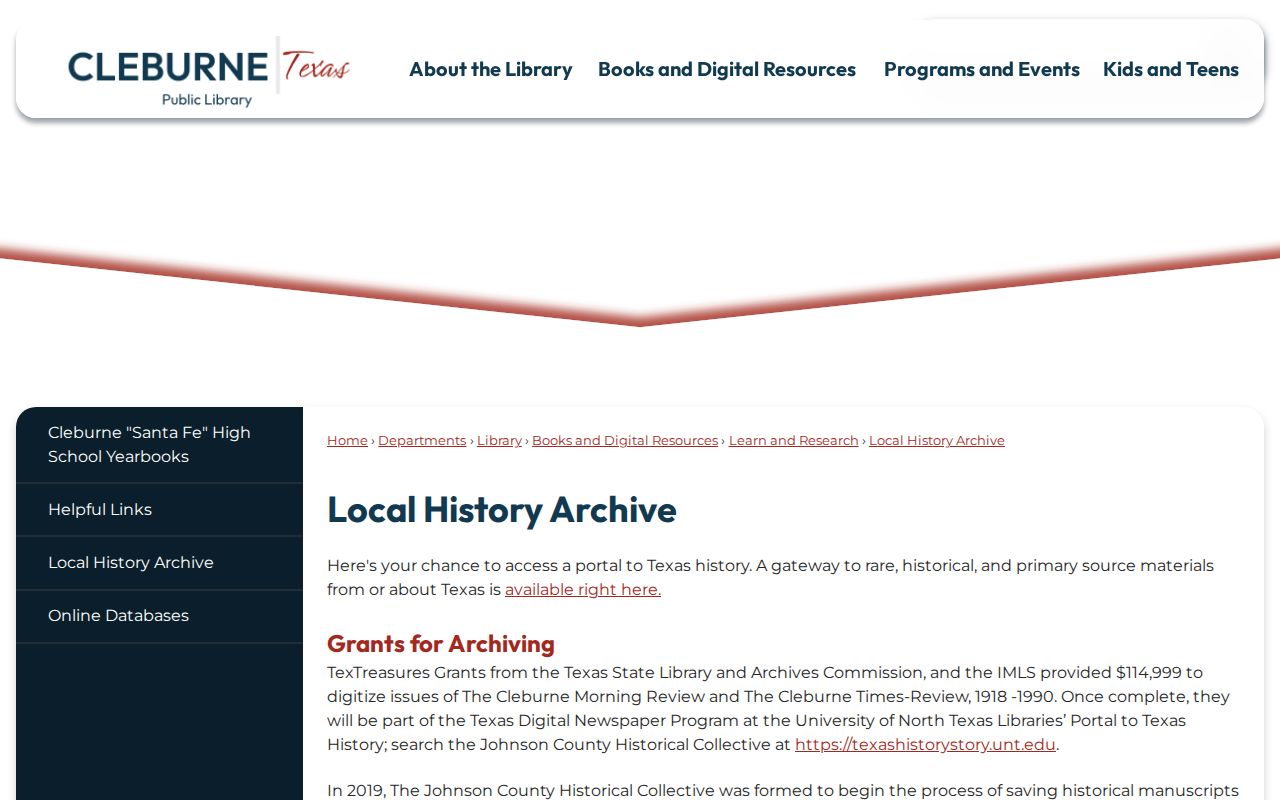
Use the archive to identify a title and date first, then ask for the corresponding microfilm when the required issue has not yet been posted online.
Layland Museum occupies the 1905 Carnegie Library building at 201 N. Caddo Street. Its Smith History Center and Gillespie Research Library are available by appointment or scheduled program. The Johnson County Historical Commission's Courthouse Museum also keeps local historic-resource context. These are human fallbacks for a precise request, such as a directory year, newspaper issue, map sheet, or microfilm reel.
Note: A repository may hold a relevant item without offering a full-text name search, so record the requested title and date before contacting staff.
Cleburne Telephone Directory Years
The UT Austin Cleburne telephone-directory citation identifies SBC as publisher and area code 817. It lists isolated early years, then runs from 1952 through 2005 with gaps. A telephone directory can preserve a subscriber name, business listing, street address, exchange, or number. It is not a complete roster of everyone at an address. Unlisted numbers, omitted households, and nearby communities make the volume's place line and date essential evidence.
The UT citation record is the source for the documented telephone-directory sequence and its multi-community coverage.
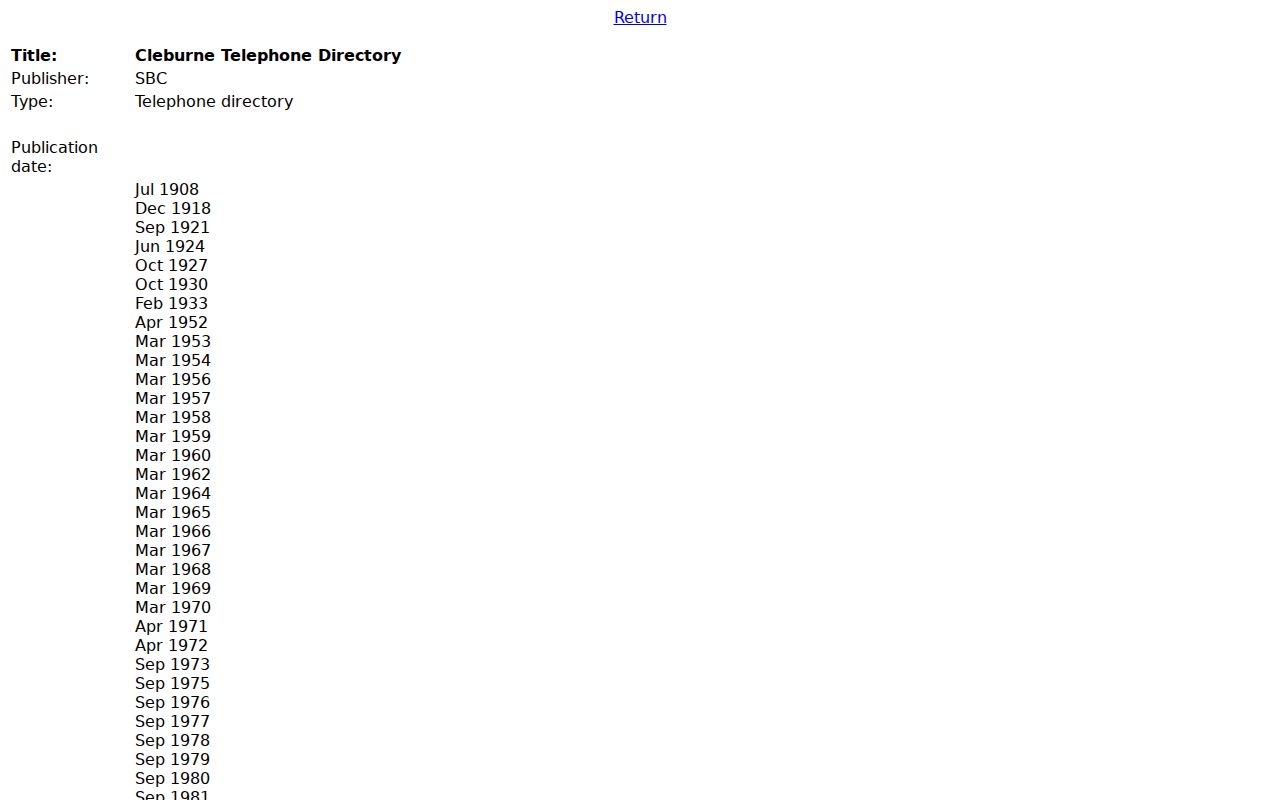
When a name changes form between volumes, compare initials, spouse notation, a street address, and any business name before treating two entries as one person.
Texas Tech's Cleburne collections finding aid separately lists the 1900-1901, volume 2, and 1907 Cleburne volumes. It also identifies clippings on people, schools, churches, transportation, and industry. Those companion materials can clarify a name that appears only as initials in a directory.
Cleburne Directory Timeline
The surviving sequence has useful landmarks, but it is not one publisher's uninterrupted series. Keep the date with the source type. A telephone listing, city-directory volume, newspaper issue, and archive location may each describe the same period from a different angle.
- About 1868: the Cleburne Chronicle began, opening a long newspaper trail.
- 1900-1901 and 1907: the named Cleburne directory volumes listed by Texas Tech were issued.
- 1908: the earliest documented UT telephone-directory citation for Cleburne appears.
- 1934: the Times-Review name begins, continuing the local newspaper line.
- 1952-2005: the UT telephone sequence resumes with gaps after the earlier isolated years.
The library's digitization is a separate layer. Earlier grants covered 1918-1969, and the 2025 grant extended work to 1970-1990. Microfilm is still necessary for some issues and years.
Cleburne Newspapers Between Directory Years
Newspapers are the practical bridge when a Cleburne city directory year is absent. The UNT Johnson County and Cleburne collection reported 17,829 items across 17 titles and 16 decades. Search a surname with a street, occupation, or local organization, then open the page image because OCR can misread initials and older type. Obituaries, legal notices, school events, civic reports, and business advertisements may place a family in a period that the directory sequence skips.
The UNT collection page is the online starting point for the digitized newspaper layer.
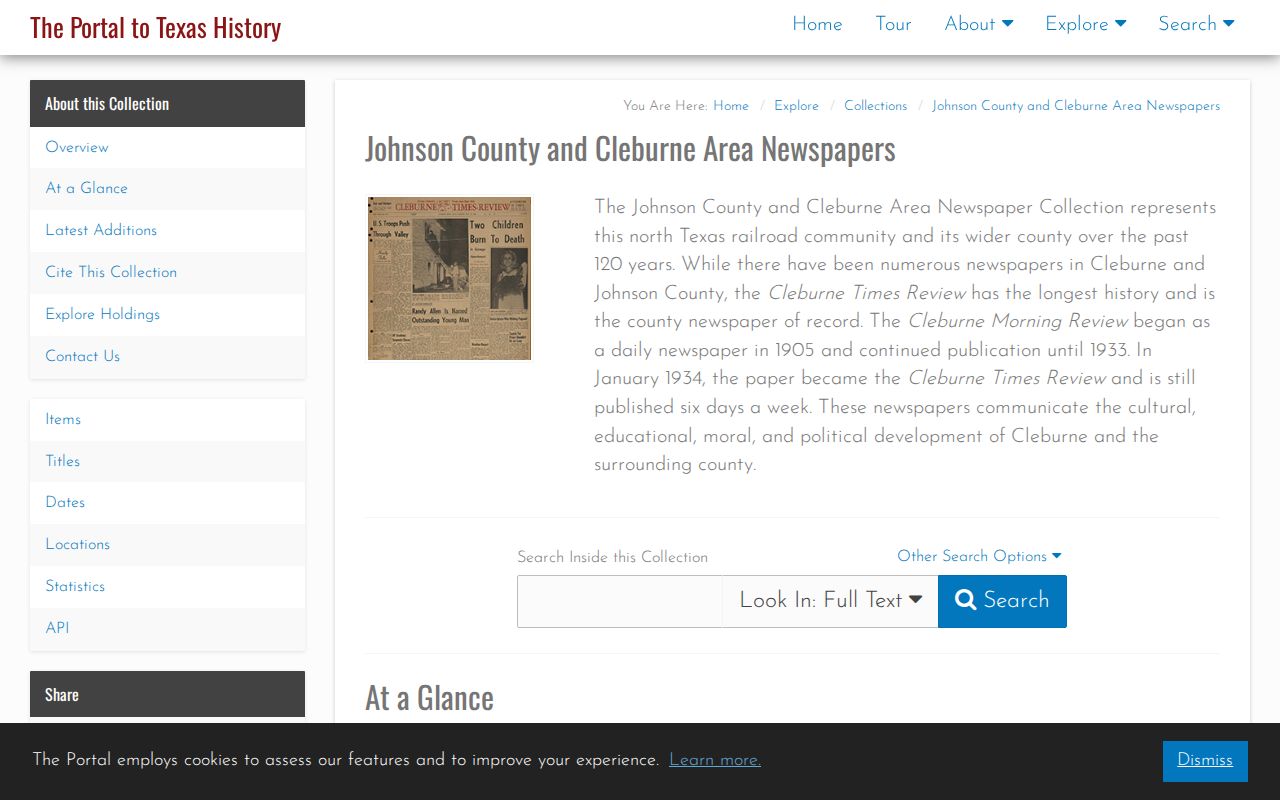
The 2025 library grant covered Times-Review microfilm from 1970 through 1990 after earlier grants covered 1918 through 1969, expanding the searchable run without making it complete.
Reading a Cleburne City Directory Entry
Capture the details printed in the actual entry, not a guessed expansion. Historical city and telephone entries can combine a surname, given name or initial, spouse or household notation, occupation or business, street address, and telephone information. Some volumes may contain owner or widow notation, but the research did not locate a Cleburne entry image or printed abbreviation key. Photograph or transcribe the key in the volume before interpreting abbreviations.
| Name form | Copy surname, given name, initials, and any alternate spelling exactly as printed. |
|---|---|
| Household clue | Note spouse, widow, boarding, or household notation only if the entry actually supplies it. |
| Occupation or business | Record the printed wording and trade name without expanding an abbreviation from memory. |
| Address | Preserve house number, street spelling, direction, rural-route wording, and telephone exchange or number. |
| Volume reference | Save repository, title, year, page, and image or reel reference for later checking. |
- Criss-cross directory
- An address-ordered section, when a particular volume includes one, checked after the alphabetical name entry.
- Householder index
- A listing organized around a household head rather than every person who may have lived at the address.
- Abbreviation key
- The volume's own explanation of marks and shortened words. Read it before interpreting shorthand.
Cleburne Directory Names and Rail Work
Railroad history explains why a Cleburne city directory entry may contain company or shop language worth searching in other local records. Santa Fe central machine shops opened in 1898-1899 and helped drive the city's growth from 7,493 people in 1900 to 12,820 in 1920. The Gulf, Colorado and Santa Fe, later connections to Dallas and Weatherford, the interurban, and the local streetcar created names that can recur in newspapers, census schedules, cemetery records, and business listings.
This local-history clue is not a presumption about any person. Search the exact words from the directory entry, then compare the nearest newspaper date and census. A local business may be indexed under a legal or assumed name while a person is listed under initials or a married surname.
Trace Cleburne City Directory Households
Follow one household through the nearest available directory years, then pair each decade with a released federal census. Federal schedules become public under the National Archives 72-year rule. Cleburne and Johnson County material begins in 1860, although changing precincts, city labels, and boundaries mean an address may not carry forward in the same form. Directories supply frequent snapshots; a census supplies a dated household composition. Neither should be substituted for the other.
- Find the earliest available city or telephone entry for the name and copy its address, name form, and other printed details.
- Check the next listed year, noting moves, changes in initials, spouse notation, and any business wording.
- Where the volume has an address section, inspect it page by page and compare nearby entries without assuming a full reverse run exists.
- Pair the closest directory year with the nearest released census, then account for a changed precinct or street form.
- Use a newspaper issue, deed, cemetery record, or probate source to test a disappearance from the sequence.
For a present-day parcel or a named-street record trail, the Cleburne street directory has the current address-keyed sources. An old directory entry remains historical evidence. A missing name can reflect a move, an unlisted telephone, a changed spelling, or a gap in the surviving series.
The 1912 Cleburne Courthouse Fire
On April 15, 1912, a fire destroyed the Johnson County Courthouse and killed Marshal Marion Abe Bledsoe while he assisted firefighters. The current courthouse was completed in 1913. This local event matters because a missing item should be traced through county microfilm and archival channels before anyone concludes that no record existed. It does not support a claim that all records were lost.
Texas State Library microfilm identifies deed records from 1853 to 1911, probate and court series, marriages, and district records with reel-level gaps. Marriage records from 1854 through 1860 were reported stolen, though a transcript made before the theft was published in Footprints. Missing deed Volume J and an unfilmed Volume 86 are further reasons to cite a gap plainly.
Note: A negative result is strongest when it identifies the repository, volume or reel, date searched, and any documented records gap.
Cleburne Directory Access Limits
City directories, telephone books, newspaper notices, and census schedules are selective sources. They do not prove every person at an address, and they can preserve an old mailing address after a move. Keep an evidence log with the repository, year, page, search spelling, and a distinction between what the record states and what the researcher infers. For living people, use records only for lawful personal, family-history, estate, or community-history purposes. Do not use a name or address to stalk, harass, or harm anyone.
The strongest Cleburne city directory result is usually a small set of matching facts from separate dated sources, not one isolated entry. Verify any current claim with the office that holds the contemporary record.